Manitoba Workplace Harassment Policy: A Plain-English Employer Guide for 2026
Learn Manitoba workplace harassment policy duties, complaint procedures, investigations and posting rules. Download the free Manitoba template.
Introduction
Last updated: August 13, 2026
Reading time: approximately 27 minutes
Every employer covered by Manitoba's provincial workplace safety and health regime must develop and implement a written harassment prevention policy. The policy cannot be a one-line promise to maintain a respectful workplace. Manitoba's Workplace Safety and Health Regulation requires specific statements, complaint and investigation procedures, a method for telling the complainant and alleged harasser about the results, worker-side consultation and conspicuous posting.
Manitoba also uses a definition that needs careful reading. “Objectionable conduct” and “severe conduct” are two different routes to workplace-safety harassment. The first is tied to listed protected characteristics and a risk to health. The second can cover conduct that is not based on a protected characteristic, but it must satisfy the regulation's repetition or lasting-harm test. An employer that blends the two routes together may reject a valid concern or apply the wrong legal test.
This guide explains the current Manitoba requirements in plain English. It is built around Canada Policy Manual's Manitoba template and focuses on turning the written policy into a process that workers can actually use.
Start with the Manitoba-specific document: Download the free Manitoba Workplace Harassment Prevention Policy Template. Replace every placeholder and complete the consultation, posting, reporting and implementation work before issuing it.
Sources
Quick answer: what must a Manitoba employer do?
Part 10 of Manitoba's Workplace Safety and Health Regulation applies to every provincially regulated employer. The employer must develop and implement a written harassment prevention policy and ensure workers comply with it.
In practical terms, the employer must:
- consult the workplace safety and health committee, the representative, or workers when neither exists;
- put all six required statutory statements in the policy;
- explain how a worker makes a harassment complaint;
- explain how the employer will investigate a complaint;
- explain how the complainant and alleged harasser will be informed of the investigation results;
- protect names and circumstances from disclosure except where disclosure is necessary to investigate, take corrective action or comply with law;
- take corrective action against a person under the employer's direction who harasses a worker;
- preserve the worker's right to complain to the Manitoba Human Rights Commission and pursue other legal rights;
- post the policy conspicuously at the workplace; and
- implement the policy, not merely approve and file it.
Manitoba does not put a universal 90-day investigation deadline, annual policy-review deadline or fixed harassment-file retention period in Part 10. An employer may adopt sensible internal targets, but it should label them as its own stronger administrative practices rather than Manitoba statutory deadlines.
This article provides general legal information and drafting guidance. It is not legal advice and cannot decide the correct jurisdiction, sector rules, collective-agreement duties, privacy requirements or response to a particular complaint.
Sources
- https://www.gov.mb.ca/labour/safety/index.html
- https://www.manitobahumanrights.ca/education-resources/resources/employment.html
- https://www.gov.mb.ca/labour/standards/index.html
The Manitoba legal framework in one view
The main workplace-safety rules are in Part 10 of the Workplace Safety and Health Regulation, M.R. 217/2006. Sections 1.1 and 1.1.1 contain the definition and legal tests. Sections 10.1 to 10.3 deal with the written policy, consultation, required content, procedures and posting.
The Workplace Safety and Health Act supplies broader duties, including the employer's duty to provide information, instruction, training and supervision necessary to protect workers' safety and health. Manitoba human-rights law can apply at the same time when conduct is connected to a protected characteristic, sexual harassment or another prohibited form of discrimination.
These legal routes overlap, but they are not identical. A workplace-safety complaint is not automatically a human-rights complaint. A human-rights violation is not decided simply by applying the Part 10 policy. A strong employer process identifies the possible routes and avoids telling a worker that the internal process is the only option.
Harassment and violence are not governed identically
The written harassment prevention policy under Part 10 is universal for provincially regulated Manitoba employers. The separate violence-prevention requirements in Part 11 are conditional.
Part 11 applies to listed workplaces, including specified health-care, pharmaceutical, educational, financial, policing, corrections, security, crisis-intervention, taxi, transit, late-night retail and licensed-premises settings. It can also apply to another workplace when the required assessment identifies a risk of violence.
If Part 11 applies, the employer needs the required violence-prevention policy, controls and training in addition to its Part 10 harassment policy. The documents may be coordinated, but the employer should not say that every Manitoba workplace automatically has the same Part 11 duties.
Sources
- https://www.gov.mb.ca/labour/safety/index.html
- https://www.manitobahumanrights.ca/education-resources/resources/employment.html
- https://www.gov.mb.ca/labour/standards/index.html
What Manitoba law means by workplace harassment
The regulation defines harassment through two alternative branches:
- objectionable conduct that creates a risk to the health of a worker; or
- severe conduct that adversely affects a worker's psychological or physical well-being.
The word “conduct” is broad. It can include a written or verbal comment, a physical act or gesture, a display, or a combination of those things. Email, messaging, video calls, shared documents, images and work-connected social-media activity can therefore be relevant.
Branch one: objectionable conduct
Conduct is objectionable for this definition when it is based on one of the characteristics listed in section 1.1.1. The list includes race, creed, religion, colour, sex, sexual orientation, gender-determined characteristics, marital status, family status, source of income, political belief, political association or political activity, disability, physical size or weight, age, nationality, ancestry and place of origin.
The conduct must also create a risk to the worker's health. The employer should look at the words or act, context, frequency, power relationship, audience and potential physical or psychological effect. It should not impose an extra repetition requirement that the objectionable-conduct branch does not contain.
Manitoba's Human Rights Code has its own current protected-characteristic language and should be checked separately. For example, gender expression became expressly protected under the Code in 2025. A practical employer policy should prohibit harassment and discrimination across all applicable human-rights grounds rather than treating the regulation's wording as the only relevant list.
Branch two: severe conduct
Conduct is severe when it could reasonably cause a worker to be humiliated or intimidated and either:
- it is repeated; or
- a single occurrence has a lasting, harmful effect on the worker.
This branch can capture serious bullying or intimidation that is not based on a listed protected characteristic. But not every unpleasant remark, disagreement or poor management interaction automatically satisfies it. The legal test still requires objectively humiliating or intimidating conduct and the specified repetition or lasting-harm feature.
The single-event route matters. An employer should not close a complaint solely because it describes one occurrence. The proper question is whether that one occurrence could reasonably humiliate or intimidate and had a lasting harmful effect.
Reasonable management is excluded
Reasonable conduct by an employer or supervisor relating to the management and direction of workers or the workplace is not harassment under section 1.1.1.
Reasonable performance feedback, scheduling, work assignment, investigation, attendance management, discipline or restructuring may therefore be legitimate. The exclusion does not protect discriminatory, retaliatory, threatening or humiliating methods. The employer should examine both the legitimate management purpose and how the decision was communicated and carried out.
Intent is not the only question
The Manitoba tests focus on the nature and effect of the conduct, not only the speaker's stated intention. “I was joking” does not decide whether a comment was based on a protected characteristic, created a health risk or could reasonably humiliate or intimidate.
An investigator should consider the full context, including power differences, prior interactions, tone, witnesses, workplace culture, the worker's response and objective evidence. Silence, nervous laughter or delayed reporting does not necessarily mean the conduct was welcome.
Third-party and digital conduct
Harassment may come from a customer, patient, resident, student, contractor, supplier, visitor or member of the public. The employer's ability to discipline a third party may be limited, but its duty to protect workers and correct workplace conditions does not disappear.
Controls may include service-withdrawal rules, visitor restrictions, contract terms, security escalation, staffing, barriers, safe communication channels and banning a repeat offender from the site. Digital complaints require early preservation of messages, account records, screenshots and platform data.
Sources
- https://www.gov.mb.ca/labour/safety/index.html
- https://www.manitobahumanrights.ca/education-resources/resources/employment.html
- https://accessibilitymb.ca/
- https://www.gov.mb.ca/labour/standards/index.html
The six statements every Manitoba policy must contain
Section 10.2 requires six core statements. Employers should write them clearly rather than hiding them in a general values section.
1. Every worker is entitled to a harassment-free workplace
The policy must state that every worker is entitled to work free of harassment. Use direct language. The statement should apply regardless of job level, employment status, schedule or work location.
2. The employer has a prevention duty
The policy must say that the employer will ensure, so far as is reasonably practicable, that no worker is subjected to harassment in the workplace. This language connects the promise to prevention and implementation.
3. Corrective action will be taken
The policy must state that the employer will take corrective action against a person under its direction who subjects a worker to harassment. Corrective action should be proportionate and may include direction, education, monitoring, work redesign or discipline up to termination.
The phrase “under its direction” matters. A customer may not be disciplinable as an employee, but the employer can still use access restrictions, service limits, contract enforcement, security measures and other controls.
4. Names and circumstances will be kept confidential within limits
The policy must state that the name of the complainant or alleged harasser and the circumstances of the complaint will not be disclosed except where disclosure is necessary to investigate the complaint or take corrective action, or where law requires disclosure.
Do not promise complete secrecy. Fairness normally requires enough disclosure for the responding person to understand and answer the allegations. Witnesses may need selected information. Decision-makers, advisers, regulators or police may need information for legitimate purposes.
5. Workers may complain to the Manitoba Human Rights Commission
The policy must state that a worker has the right to file a complaint with the Manitoba Human Rights Commission. The internal policy is not a substitute for that external right.
The employer should avoid giving definitive limitation-period advice unless current, qualified advice has been obtained. Provide the Commission's current contact or website and encourage prompt advice.
6. Other legal rights remain available
The policy must state that it is not intended to discourage or prevent the complainant from exercising any other legal right. Depending on the facts, those routes may include Workplace Safety and Health, a union grievance, workers compensation, police, a privacy regulator, a professional body or a court or tribunal.
Sources
- https://www.wcb.mb.ca/employers/report-an-injury/
- https://www.gov.mb.ca/labour/standards/index.html
- https://www.gov.mb.ca/labour/safety/index.html
- https://www.manitobahumanrights.ca/education-resources/resources/employment.html
- https://web2.gov.mb.ca/laws/statutes/ccsm/l010.php
Required procedures: complaint, investigation and results
Manitoba requires the policy to set out procedures for three things: making a complaint, investigating it, and informing the complainant and alleged harasser of the investigation results.
The regulation does not prescribe every procedural detail. That gives employers flexibility, but it also means the policy must supply a workable process rather than rely on vague promises.
Create more than one reporting route
The policy should name the ordinary complaint recipient and a credible alternate. An alternate route is particularly important where the ordinary recipient, owner, executive or human-resources leader is accused or has a conflict.
Accept oral and written reports. A form can help collect dates, words, witnesses, documents and safety concerns, but it should not become a barrier. Workers should not need legal terminology, a perfect chronology or direct proof before the employer receives the concern.
A sound reporting procedure explains:
- who can report, including a witness or representative;
- where and how to report;
- what information is helpful but not mandatory;
- what to do outside regular hours;
- the emergency route for threats or violence;
- the alternate route for conflicts or senior-leadership allegations;
- how accessibility, language or disability needs will be addressed; and
- what happens after the employer receives the report.
Managers who observe conduct or receive information should not wait indefinitely for a signed complaint. The employer may have enough knowledge to assess risk and act.
Triage safety before deciding the merits
The first response should assess immediate danger, injury, violence, retaliation, evidence loss, accommodation and investigator conflicts. The intake person should also determine whether Part 11, emergency services, child or vulnerable-person reporting, a serious-incident rule or another mandatory process may apply.
Interim measures can include no-contact directions, security support, reporting-line changes, schedule or location adjustments, remote work, temporary reassignment or paid leave. They are not a finding of misconduct. They should be proportionate, documented, reviewed and designed to avoid penalizing the person who raised the concern.
Decide whether informal resolution is suitable
Coaching, facilitated discussion or mediation can sometimes resolve lower-level conflict when participation is voluntary and safe. Informal resolution is usually unsuitable for violence, serious sexual or discriminatory conduct, retaliation, coercion, repeated severe conduct or a major power imbalance.
Do not force the complainant to confront the alleged harasser. Do not use mediation to avoid investigating a matter that requires factual findings or corrective action.
Use a fair investigation process
The employer's policy should explain the investigation steps. A suitable process normally includes:
- identifying the allegations and applicable policy tests;
- screening the investigator for bias, conflict and needed competence;
- giving the responding person enough detail and time to respond;
- interviewing the parties separately;
- interviewing relevant witnesses;
- collecting and preserving messages, documents and other relevant evidence;
- allowing the parties to address important contradictory evidence;
- assessing credibility without stereotypes;
- making findings on the balance of probabilities; and
- recording reasons and recommended corrective action.
An internal investigator may be suitable for a straightforward concern if that person is impartial, trained and sufficiently independent. An external investigator is often safer when the allegation involves an owner or senior leader, serious sexual conduct, violence, complex credibility issues, multiple complainants or a reasonable concern about internal independence.
Do not invent a Manitoba statutory deadline
Part 10 does not impose a universal 90-calendar-day deadline for every harassment investigation. The investigation should still begin promptly and proceed diligently.
The Canada Policy Manual template uses 90 days as an enhanced internal target, with recorded reasons and regular updates when complexity, availability, accommodation or a parallel process requires longer. If adopted, that target becomes an employer commitment. It should not be described as a statutory Manitoba deadline.
Inform both parties of the results
The policy must explain how the complainant and alleged harasser will be informed of the investigation results. A written closure summary is usually the clearest approach.
The summary can state whether each allegation was substantiated, partly substantiated or not substantiated, and identify corrective or preventive steps relevant to the recipient. It should not automatically disclose the full investigation report, witness statements, confidential medical information or unnecessary disciplinary detail.
An unsubstantiated complaint does not mean it was dishonest. A knowingly fabricated material allegation may be addressed through a separate fair process, but an employer should not punish a worker merely because evidence was insufficient.
Sources
- https://www.gov.mb.ca/labour/standards/index.html
- https://www.gov.mb.ca/labour/safety/index.html
- https://www.manitobahumanrights.ca/education-resources/resources/employment.html
- https://accessibilitymb.ca/
Confidentiality, records and committee information
Controlled confidentiality supports safety and fairness. Restrict access to people who need information to receive the complaint, protect people, investigate, decide, correct conditions, obtain advice or comply with law.
Keep complaint and investigation material in a secure case file outside routine personnel files. Final disciplinary documents may belong in the proper employment file, but raw allegations and witness material should not be broadly accessible.
Part 10 does not prescribe one universal retention period for harassment case files. An employer should choose and document a defensible period after considering privacy law, employment and human-rights limitation periods, litigation holds, recurrence risk, collective agreements and sector duties. The Canada Policy Manual template uses seven years as an enhanced administrative default, subject to those rules.
Manitoba's Act contains a special disclosure rule for harassment investigations. A harassment investigation report is excluded from the general requested-report disclosure rule. However, on request, the employer must provide the committee, representative or, if neither exists, a worker with a summary of the harassment investigation results that omits the circumstances and identifying information. Employers should obtain current advice before responding to a particular request.
Sources
- https://www.gov.mb.ca/labour/safety/index.html
- https://www.gov.mb.ca/labour/standards/index.html
- https://accessibilitymb.ca/
- https://web2.gov.mb.ca/laws/statutes/ccsm/l010.php
Post the policy conspicuously and make it usable
Section 10.3 requires the harassment prevention policy to be posted conspicuously at the workplace. A signed policy hidden in a manager's drive does not meet that requirement.
Post the current version where workers are likely to see it. For remote, hybrid or mobile workers, also provide an accessible electronic copy. Electronic access is a practical enhancement; it should supplement, not silently replace, the conspicuous workplace posting required by the regulation.
Check that workers can identify the complaint recipient, alternate recipient and current contact details without asking the person they may need to complain about. Provide alternate formats or language support where needed.
Sources
- https://www.gov.mb.ca/labour/safety/index.html
- https://accessibilitymb.ca/
- https://www.gov.mb.ca/labour/standards/index.html
Training and implementation
Part 10 does not list a universal set of harassment-training subjects in the way some other provinces do. Manitoba's Act nevertheless requires the information, instruction, training and supervision necessary to protect safety and health, and section 10.1 requires implementation and worker compliance.
A practical training program should cover:
- the two Manitoba harassment branches and examples;
- reasonable management conduct;
- the policy's normal and alternate reporting routes;
- emergency and violence procedures;
- confidentiality limits and protection against retaliation;
- what happens during an investigation;
- the rights of complainants, respondents and witnesses;
- supervisor intake and escalation duties;
- bystander reporting and evidence preservation; and
- supports, accommodation and external rights.
Training should use workplace-specific examples. Record the date, content, trainer, attendance and any competency check. Refresh training when contacts, risks, procedures or the law change.
Sources
- https://www.gov.mb.ca/labour/safety/index.html
- https://www.manitobahumanrights.ca/education-resources/resources/employment.html
- https://www.gov.mb.ca/labour/standards/index.html
Review and continuous improvement
Part 10 does not state a universal annual review interval. Employers should not label an annual cycle as an express statutory requirement.
Annual review is still a sensible enhanced control. Review sooner after a serious incident, repeated concern, legal change, organizational restructuring, change in reporting contacts, failed procedure or evidence that workers do not trust or understand the system.
Use anonymized information. Look for delays, recurring departments or third parties, retaliation concerns, incomplete corrective action and reporting routes that were unavailable or conflicted. Consult the appropriate workplace party on material revisions and repost the current version.
Sources
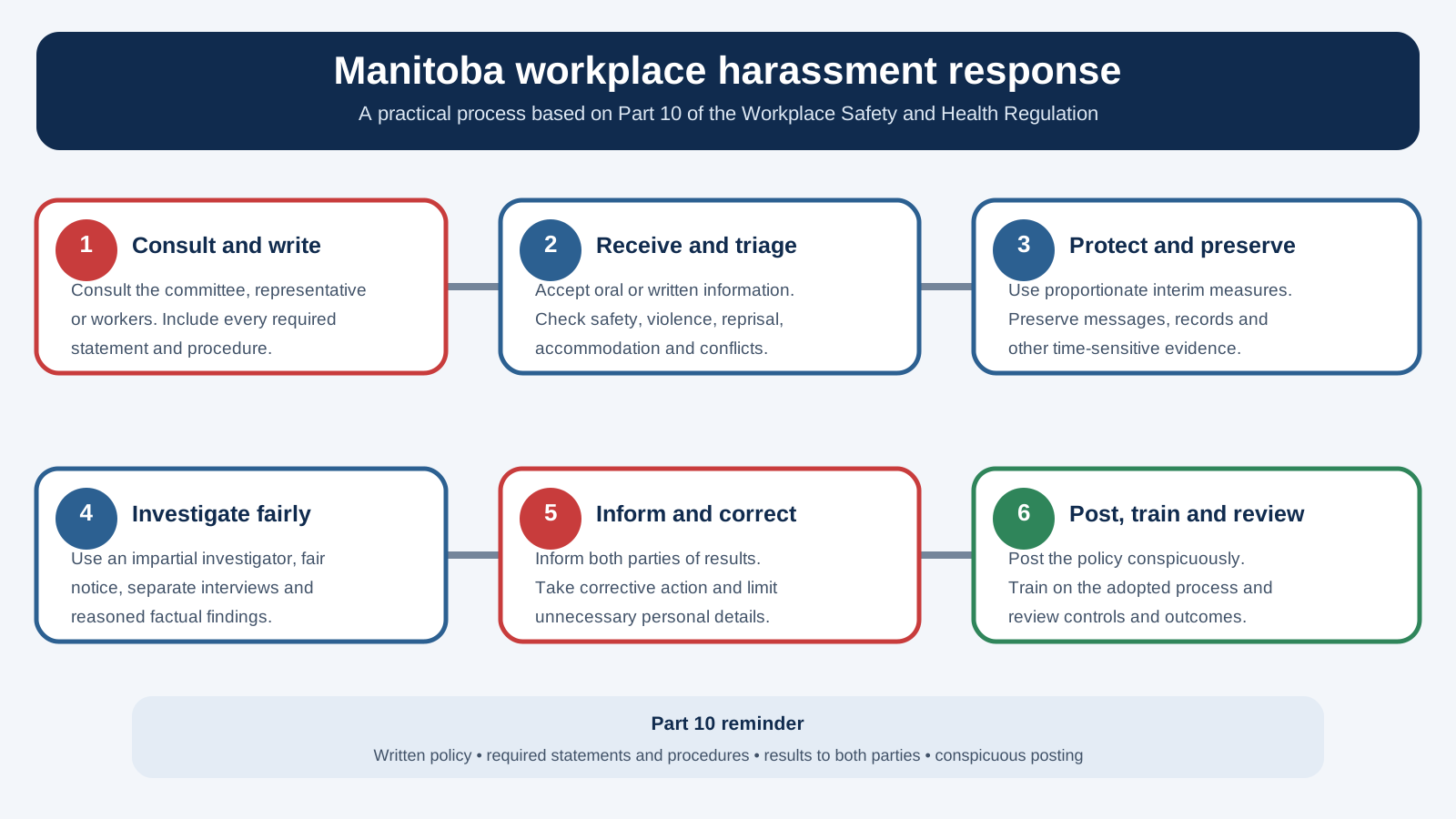
A six-step Manitoba response process
Sources
Practical example 1: repeated humiliation not tied to a protected characteristic
A warehouse supervisor repeatedly calls one worker “useless” during team meetings, mocks the worker's questions and tells co-workers not to help. The behaviour continues for several weeks. There is no evidence it is based on a protected characteristic.
The employer should not dismiss the concern merely because the objectionable-conduct branch may not apply. The severe-conduct branch asks whether the conduct could reasonably humiliate or intimidate and is repeated. Public insults and deliberate isolation may satisfy that test.
A proper response would preserve meeting messages and schedules, interview the worker, supervisor and witnesses separately, examine the frequency and context, and consider interim measures. The employer should also assess whether supervisory culture, unclear accountability or fear of reporting is a broader hazard.
This fictional example is educational. Real findings depend on the evidence and full circumstances.
Practical example 2: a single protected-ground comment
During a client meeting, a manager makes one degrading comment about an employee's ancestry. Several people hear it. The employee reports distress and worries that challenging the manager will affect future assignments.
The employer should not add a repetition requirement to the objectionable-conduct branch. It should examine whether the comment was based on a listed characteristic and created a risk to the worker's health. Human-rights law may also apply.
The intake person should use an alternate recipient if the manager controls the ordinary route, preserve the meeting record and witness information, assess retaliation and conduct a fair investigation. Corrective action may need to address both the individual conduct and the power structure that discouraged reporting.
This fictional example is educational. It is not a prediction of a tribunal result.
Real Manitoba case study: Smith v. New Age Automation Group Inc.
The Manitoba Human Rights Adjudication Panel's October 30, 2024 decision in Smith v. New Age Automation Group Inc. is a serious example of workplace sexual harassment and misuse of power. It is a Human Rights Code case, not a Part 10 enforcement decision, but its lessons are highly relevant to policy design and employer response.
Britney Smith worked as an executive assistant. The respondent company's owner, president and sole director made ongoing sexual comments and solicitations, engaged in unwanted touching and used threats and his workplace power in a way that the adjudicator found exploitative. The conduct persisted and escalated. Ms. Smith eventually resigned.
The panel described the conduct as egregious and invasive and found that some of it constituted sexual assault. The power imbalance mattered: the person engaging in the conduct controlled the company and the complainant's employment. A paper complaint route pointing back to that same person would not have been safe or credible.
The panel ordered $25,000 for injury to dignity, feelings and self-respect. It also ordered $85,893.11 for lost wages, subject to the deductions and treatment set out in the decision, and required human-rights training for the individual respondent and, if applicable, the company. The panel declined to order an apology because an insincere apology could be hollow rather than restorative.
The case teaches several practical lessons:
- a senior leader or owner can be the source of the risk;
- the policy needs a truly independent alternate reporting route;
- sexual comments, touching, coercion and threats must not be minimized as personality conflict;
- delayed reporting or continued employment does not make conduct welcome;
- power and economic vulnerability affect how workers respond;
- serious allegations may require an external investigator and immediate protective measures; and
- financial and organizational consequences can extend far beyond ordinary discipline.
Employers should read the official Smith decision rather than relying on a summary when applying its legal reasoning.
A shorter supporting Manitoba decision
In T.M. v. Government of Manitoba — Manitoba Justice, a correctional-facility employee experienced ongoing harassment based on sexuality. The Manitoba Human Rights Commission's official 2019 release reports that the employer's response after the report was inadequate. The decision reinforces that an employer must take a concern seriously, investigate properly where possible and still act to stop harassment even when a perfect investigation cannot be completed. Remedies included training, a Respectful Workplace Advisor and $75,000 in damages. This is a supporting example; Smith is the one detailed case study in this article.
Sources
- https://www.gov.mb.ca/labour/safety/index.html
- https://www.manitobahumanrights.ca/education-resources/resources/employment.html
- https://www.gov.mb.ca/labour/standards/index.html
Common Manitoba policy mistakes
Treating every rude act as statutory harassment
Unprofessional conduct may require management even when it does not meet the regulatory test. Use a respectful-work standard for broader conduct, but do not misstate the legal definition.
Requiring repetition in every case
The objectionable-conduct branch does not contain the severe branch's repeated-or-lasting-harm formula. A single event may also satisfy the severe branch if it has a lasting harmful effect.
Requiring a signed written complaint
Part 10 requires a complaint procedure; it does not say an employer may ignore oral information. A mandatory form can silence workers and delay protection.
Naming only the direct supervisor
The procedure fails when the supervisor is accused or conflicted. Name a monitored alternate with authority to act independently.
Promising complete confidentiality
A fair investigation and lawful correction require limited disclosure. Promise controlled, need-to-know handling, not impossible secrecy.
Giving only one party the result
The policy must explain how both the complainant and alleged harasser will be informed of the investigation results.
Hiding the policy online or in a binder
Manitoba requires conspicuous workplace posting. Make the current version visible and also accessible to remote workers.
Copying another province's deadlines
Ontario's approved-code timing method and Alberta's three-year review rule are not Manitoba Part 10 requirements. If an employer selects a 90-day target or annual review, label it accurately as an internal enhanced practice.
Confusing universal harassment duties with conditional violence duties
Every provincially regulated Manitoba employer needs the Part 10 harassment policy. Part 11 violence duties depend on the workplace category or risk assessment.
Stopping after the investigation
A finding is not a control. Assign corrective actions, deadlines and owners, check effectiveness and watch for retaliation.
Sources
- https://www.ontario.ca/page/workplace-health-and-safety
- https://www.alberta.ca/occupational-health-safety
- https://www.gov.mb.ca/labour/safety/index.html
- https://www.ontario.ca/page/accessibility-laws
- https://www.alberta.ca/employment-standards
- https://accessibilitymb.ca/
- https://www.ontario.ca/document/your-guide-employment-standards-act-0
- https://www.gov.mb.ca/labour/standards/index.html
Manitoba implementation checklist
- We confirmed that Manitoba's provincial regime applies to the workplace.
- We checked whether a sector-specific rule, collective agreement or Part 11 violence duty also applies.
- We consulted the committee, representative or workers and retained the consultation record.
- The policy contains all six statements required by section 10.2.
- The policy accurately explains objectionable and severe conduct as alternative branches.
- We named a normal complaint recipient and a credible alternate.
- We accept oral, written, witness and representative reports in accessible formats.
- We linked the policy to emergency, violence, accommodation and support procedures.
- Our investigation process includes conflict screening, fair notice, interviews, evidence preservation, findings and reasons.
- We explain how the complainant and alleged harasser receive results.
- We use controlled confidentiality and do not promise secrecy.
- Corrective actions have owners, deadlines and effectiveness checks.
- We selected a defensible record-retention rule and secured case files.
- The current policy is posted conspicuously and accessible to remote workers.
- Workers and supervisors have practical training on the adopted procedure.
- Any 90-day target, annual review or seven-year retention period is labelled as an employer practice, not a universal Part 10 deadline.
- We monitor for retaliation and preserve external legal rights.
For a wider review of documentation readiness, use the free Compliance Gap Checker. The Manitoba harassment template remains the primary resource for this article.
Ready to customize the Manitoba document? Download the free Manitoba Workplace Harassment Prevention Policy Template. It includes the policy framework and operational schedules for consultation, assessment, intake, investigation, corrective action, training and review.
Sources
- https://www.gov.mb.ca/labour/safety/index.html
- https://www.manitobahumanrights.ca/education-resources/resources/employment.html
- https://accessibilitymb.ca/
- https://web2.gov.mb.ca/laws/statutes/ccsm/l010.php
- https://www.gov.mb.ca/labour/standards/index.html
How to customize the free Manitoba template
Start with the employer's legal name, covered locations, accountable officer, consultation record, ordinary and alternate recipients, emergency contacts, supports, effective date and posting locations.
Next, replace generic examples with the actual risks in the workplace. Consider leadership power, customer contact, remote work, digital systems, public interaction, young or temporary workers, licensed premises, night work and previous concerns. If Part 11 applies, complete the required violence assessment and policy work rather than assuming the harassment document alone is enough.
Set a realistic intake and investigation process. Decide who appoints the investigator, when an external investigator is required, where evidence is stored, how parties receive updates, who issues closure summaries and who verifies corrective action.
Choose internal service targets only after confirming they can be met. A prompt 90-day investigation goal, annual review and seven-year retention default can strengthen the system, but each should be labelled accurately and adjusted for applicable privacy, sector and collective-agreement rules.
Train workers on the final, customized document. A generic slide deck is not enough if workers cannot identify the reporting contacts, locate the posted policy or explain what happens after a complaint.
Employers that want a broader organization-specific manual can create a Canada Policy Manual account. The free Manitoba harassment template should remain directly accessible without requiring a paid subscription.
Sources
- https://www.gov.mb.ca/labour/safety/index.html
- https://www.gov.mb.ca/labour/standards/index.html
- https://accessibilitymb.ca/
Frequently asked questions about Manitoba workplace harassment policies
Does every Manitoba employer need a workplace harassment policy? Every employer covered by Manitoba's provincial workplace safety and health regime must develop and implement a written harassment prevention policy under Part 10. Federally regulated workplaces follow the federal regime instead.
What must the Manitoba policy say? It must include the six statements in section 10.2 and procedures for making a complaint, investigating it and informing the complainant and alleged harasser of the results.
Must workers be consulted? Yes. The employer develops the policy in consultation with the workplace safety and health committee, the representative or workers when neither exists.
Must the policy be posted? Yes. It must be posted conspicuously at the workplace. Electronic access is a useful addition for remote and mobile workers.
Can one incident be harassment in Manitoba? Yes. The objectionable-conduct branch does not require repetition. A single severe occurrence can also qualify when it has a lasting harmful effect and could reasonably humiliate or intimidate.
Does bullying have to involve a protected characteristic? Not always. Severe repeated conduct that could reasonably humiliate or intimidate may qualify even without a protected-ground connection. The correct severe-conduct test must still be applied.
Is reasonable performance management harassment? Reasonable conduct relating to management and direction is excluded. Discriminatory, retaliatory, threatening or humiliating methods may not be reasonable.
Must a complaint be written? Part 10 requires the employer's policy to explain how complaints are made; it does not impose a universal signed-form requirement. A strong procedure accepts oral and written information.
Is there a 90-day Manitoba investigation deadline? Part 10 does not impose a universal 90-calendar-day deadline. Employers may adopt a prompt internal target and explain extensions, but should not call it a statutory Manitoba deadline.
Who must receive the investigation results? The policy must explain how both the complainant and alleged harasser will be informed of the results. This does not mean both automatically receive the full report.
Can the employer promise complete confidentiality? No. Disclosure may be necessary to investigate, take corrective action or comply with law. The policy should promise limited, need-to-know handling.
How long must Manitoba harassment files be kept? Part 10 does not set one universal retention period. Employers should adopt a defensible rule after considering privacy, limitation periods, litigation holds, sector rules and collective agreements.
Does every Manitoba employer also need a violence policy? No. Part 11 applies to listed workplaces and other workplaces where the required assessment identifies a risk of violence. The universal Part 10 harassment policy and conditional Part 11 violence duties should not be confused.
How often must the Manitoba harassment policy be reviewed? Part 10 does not prescribe a universal fixed review interval. Annual review is a strong internal practice, with earlier review after legal change, an incident, organizational change or procedure failure.
Sources
- https://www.gov.mb.ca/labour/safety/index.html
- https://www.canada.ca/en/employment-social-development/programs/workplace-health-safety.html
- https://www.manitobahumanrights.ca/education-resources/resources/employment.html
- https://www.chrc-ccdp.gc.ca/individuals/human-rights/about-discrimination
- https://www.gov.mb.ca/labour/standards/index.html
- https://www.priv.gc.ca/en/privacy-topics/employers-and-employees/
- https://web2.gov.mb.ca/laws/statutes/ccsm/l010.php
- https://laws-lois.justice.gc.ca/eng/acts/l-2/index.html
Final takeaway
A Manitoba workplace harassment policy must do more than express respect. It must contain the required statements, be developed through the required consultation, establish usable complaint and investigation procedures, tell both parties how results are communicated, protect confidentiality within lawful limits and be posted conspicuously.
The strongest policy also gets the Manitoba definition right. It keeps objectionable conduct separate from severe conduct, recognizes that one incident can sometimes qualify, provides an independent alternate reporting route and distinguishes universal Part 10 duties from conditional Part 11 violence duties.
Download the free Manitoba Workplace Harassment Prevention Policy Template, then customize and implement it for the real workplace.
Authoritative Manitoba sources
- Workplace Safety and Health Regulation, M.R. 217/2006
- The Workplace Safety and Health Act
- Manitoba Human Rights Commission
- Smith v. New Age Automation Group Inc. — official decision
Legal information notice: General information, not legal advice or a compliance guarantee. Confirm jurisdiction, current law and workplace-specific duties before adoption. Laws and circumstances may change after August 13, 2026.
Sources
- https://www.gov.mb.ca/labour/safety/index.html
- https://www.manitobahumanrights.ca/education-resources/resources/employment.html
- https://www.gov.mb.ca/labour/standards/index.html
Key Takeaways
- Manitoba’s Part 10 policy duties apply to provincially regulated employers and require implementation, consultation, specific statements, usable procedures and conspicuous posting.
- Objectionable conduct and severe conduct are alternative branches with different legal tests; a single event should not be dismissed automatically.
- A credible process accepts oral and written reports, checks safety and conflicts, investigates fairly, informs both parties of results and assigns corrective action.
- Internal targets such as 90-day investigations, annual review and seven-year retention must be labelled as employer practices, not universal Part 10 deadlines.
Disclaimer: General information, not legal advice or a compliance guarantee. Confirm jurisdiction, current law and workplace-specific duties before adoption. Laws and circumstances may change after August 13, 2026.