Saskatchewan Workplace Harassment Policy: A Plain-English Employer Guide for 2026
Learn Saskatchewan workplace harassment policy duties, investigations, posting and violence-plan rules. Download the free Saskatchewan template.
Introduction
Last updated: August 13, 2026 · Estimated reading time: 24 minutes
Every provincially regulated employer in Saskatchewan needs a written workplace harassment policy. That policy must do more than say harassment is prohibited. It must be developed through the consultation route required by Saskatchewan law, contain specific information, be put into practice, be posted where workers can readily find it, and support an investigation into every workplace harassment incident.
This guide explains those duties in plain English. It is written for owners, managers, human resources teams, supervisors, occupational health committee members, occupational health and safety representatives, and workers who need a practical understanding of the Saskatchewan rules.
The fastest place to begin is the jurisdiction-specific template.
Primary resource: Download the Free Saskatchewan Workplace Harassment Prevention Policy Template. Customize it for the employer, consult the legally required workplace party, connect it to the workplace's violence plan, train everyone who has a role, and obtain Saskatchewan legal advice where the facts or risks require it.
Legal information notice: This article provides general educational information, not legal advice. It does not guarantee compliance or a particular legal result. Confirm that Saskatchewan provincial law governs the workplace. Federally regulated undertakings follow the federal regime even when employees work in Saskatchewan. Laws, official guidance, collective agreements and sector rules can change. Quebec is outside the scope of Canada Policy Manual's templates.
Sources
- https://www.saskatchewan.ca/business/safety-in-the-workplace
- https://www.canada.ca/en/employment-social-development/programs/workplace-health-safety.html
- https://www.saskatchewan.ca/business/hire-train-and-manage-employees/collective-bargaining-and-mediation
- https://laws-lois.justice.gc.ca/eng/acts/l-2/index.html
- https://www.saskatchewan.ca/business/employment-standards
The quick answer
A Saskatchewan employer should be able to show all of the following:
- it has a written harassment policy developed after consultation with the occupational health committee, the occupational health and safety representative, or the workers when neither exists;
- the policy contains every item prescribed by section 3-25 of The Occupational Health and Safety Regulations, 2020;
- workers can report an incident without having to confront the other person or complete a special form;
- the employer investigates every incident of workplace harassment that comes to its attention;
- the complainant and the alleged harasser are informed of the investigation results in the way the policy describes;
- names and circumstances are kept confidential except where disclosure is necessary to investigate, take corrective action, or comply with the law;
- corrective action is taken when a person under the employer's direction harasses a worker;
- the policy is implemented and conspicuously posted where it is readily available to workers;
- protected reporting, participation and requests for enforcement do not lead to discriminatory action or reprisal; and
- the employer also maintains the separate violence policy statement and prevention plan now required at every provincially regulated Saskatchewan workplace.
The last item is easy to mishandle. Saskatchewan's harassment policy and violence prevention plan are related, but they are not the same document. The regulation requires the violence plan to be reviewed at least every three years and when circumstances change. It does not state the same three-year cycle for the harassment policy. An annual harassment-policy review is a sensible enhanced practice, not a Saskatchewan statutory deadline.
Sources
- https://www.saskatchewan.ca/business/safety-in-the-workplace
- https://saskatchewanhumanrights.ca/your-rights/employment/
- https://www.saskatchewan.ca/business/employment-standards
What law governs workplace harassment in Saskatchewan?
The main occupational health and safety requirements appear in Part III of The Saskatchewan Employment Act, often shortened to the SEA, and in The Occupational Health and Safety Regulations, 2020. The downloadable King's Printer consolidations are helpful current reference copies, but each states that the consolidation is not official. Employers dealing with a live dispute, investigation or enforcement matter should confirm the operative text and obtain advice.
Section 3-21.1 of the SEA creates the central harassment-policy duties. In broad terms, the employer must develop and implement a written prevention policy after the required consultation, include the prescribed provisions, and ensure that an investigation is conducted into any incident of workplace harassment.
Section 3-25 of the regulations provides the detailed contents of that written policy. Those contents are not optional drafting suggestions. A short code-of-conduct paragraph will usually not be enough.
Human rights law can apply at the same time. Harassment connected to a protected ground may also engage The Saskatchewan Human Rights Code, 2018. Sexual harassment may engage both occupational health and safety law and human rights law. A unionized workplace may also have collective-agreement and grievance obligations. Depending on the facts, workers' compensation, privacy, criminal, professional, education, health-care or safeguarding rules may matter too.
An employer should therefore avoid treating an internal policy as the worker's only route. The Saskatchewan policy must refer to the Act's harassment provisions and the right to request assistance from an occupational health officer. It must also refer to the Human Rights Code and the right to make a complaint to the Saskatchewan Human Rights Commission. It must not discourage other legal rights.
Sources
- https://www.wcbsask.com/how-report-work-injury
- https://www.saskatchewan.ca/business/safety-in-the-workplace
- https://saskatchewanhumanrights.ca/your-rights/employment/
- https://www.saskatchewan.ca/business/employment-standards
- https://www.saskatchewan.ca/business/hire-train-and-manage-employees/collective-bargaining-and-mediation
Who is protected by the Saskatchewan rules?
The Part III concept of a worker is broader than an ordinary full-time employee. Depending on the statutory wording and relationship, coverage can include students receiving training, volunteers, and independent or dependent contractors. This matters because harassment risks often arise around people who are not on the employer's regular payroll: interns, practicum students, contracted workers, volunteers, temporary personnel and people working across organizational boundaries.
A strong policy should explain that coverage in accessible language. It should also cover conduct by or involving supervisors, managers, owners, co-workers, clients, customers, patients, students, suppliers, contractors and other work-related third parties. The employer's ability to discipline a third party may be limited, but it can still take protective and corrective steps such as changing access, amending service arrangements, notifying the third party's employer, adding security controls or ending a business relationship.
The relevant setting is not limited to a desk, store or worksite. Work-connected harassment may occur:
- in person at the workplace;
- during remote or hybrid work;
- by email, chat, text, video meeting or another digital system;
- at training, conferences, employer social events or client functions;
- during work travel, transportation or employer-arranged lodging;
- at a customer's, patient's or contractor's location; or
- outside scheduled hours when the conduct has a real connection to employment.
The Government of Saskatchewan's harassment guidance also recognizes that harassment can involve third parties and conduct outside usual work hours when there is a workplace connection. The correct question is not simply “Where did it happen?” The employer should ask whether the people, relationship, activity, effects and risk are connected to work.
Sources
- https://www.saskatchewan.ca/business/safety-in-the-workplace
- https://www.saskatchewan.ca/business/employment-standards
Saskatchewan has three harassment branches
The SEA definition is detailed. For practical policy work, it helps to separate three branches rather than combine every concern under one loose label.
| Branch | Plain-English legal focus | Important caution |
|---|---|---|
| Protected-ground or size/weight harassment | Inappropriate conduct, comment, display, action or gesture toward a worker, based on a prohibited human-rights ground or the worker's physical size or weight, that constitutes a threat to the worker's health or safety | Do not add the personal-harassment repetition or lasting-harm test to this branch |
| Personal harassment | Inappropriate conduct, comment, display, action or gesture that adversely affects psychological or physical well-being, is known or ought reasonably to be known to humiliate or intimidate, and constitutes a threat to health or safety | The special repetition/single-serious-occurrence rule and reasonable-management exclusion apply here |
| Sexual harassment | Conduct, comment, display, action or gesture of a sexual nature that the person knows or ought reasonably to know is unwelcome | It can be a single occurrence; do not import the personal-harassment test |
These distinctions affect intake, investigation and decision-making. An investigator should identify the correct branch or branches and test each element that actually applies. The investigator should not reject a sexual-harassment concern because it occurred only once, and should not assume that every discourteous interaction is personal harassment.
Protected-ground and size-or-weight harassment
This branch addresses inappropriate workplace conduct connected to a prohibited ground under Saskatchewan human rights law, or to the worker's physical size or weight, where the conduct constitutes a threat to the worker's health or safety. Examples could include a slur, hostile display, demeaning comment or targeted action connected to a protected characteristic.
The connection to the ground must be assessed from the evidence. A complainant does not need to use precise legal language at intake. If a report says, for example, that a supervisor repeatedly mocked an accent, disability-related need or religious practice, the recipient should record those facts and identify the potential protected-ground issue rather than expect the worker to name the correct legal category.
Personal harassment
Personal harassment is not a general rule against every conflict or impolite moment. The statutory branch requires inappropriate conduct, a comment, display, action or gesture that adversely affects the worker's psychological or physical well-being, that the person knows or ought reasonably to know would cause humiliation or intimidation, and that constitutes a threat to the worker's health or safety.
For this personal-harassment branch, conduct can involve repeated occurrences. One serious occurrence can also qualify if it has a lasting harmful effect on the worker. An investigation should therefore examine the pattern, seriousness, impact and health-or-safety dimension. It should not simply count incidents.
Examples that may justify investigation include sustained public humiliation, targeted yelling, malicious rumours, repeated exclusion used to intimidate, sabotage, threatening communications or a serious degrading event with lasting harm. Whether the statutory test is met depends on the evidence. The employer can still address disrespectful behaviour under a code of conduct even when every element of statutory harassment is not established.
Sexual harassment
The sexual-harassment branch covers conduct, comments, displays, actions or gestures of a sexual nature when the person knows or ought reasonably to know that the conduct is unwelcome. It may include sexual remarks, unwanted touching, sexual images, intrusive sexual questions, sexual propositions, coercion, or linking a work benefit or disadvantage to sexual attention.
A policy should never state that the person affected must first tell the other person to stop. Context can make unwelcome conduct obvious, and fear, power imbalance, trauma or safety concerns can make direct confrontation unreasonable. A single occurrence can require a full response.
Sources
- https://www.saskatchewan.ca/business/safety-in-the-workplace
- https://saskatchewanhumanrights.ca/your-rights/employment/
- https://www.saskatchewan.ca/business/employment-standards
Reasonable management action is not a blanket defence
Saskatchewan's reasonable-management provision applies specifically to the personal-harassment branch. Reasonable action relating to the management and direction of workers or the workplace is not personal harassment. That can include assigning work, setting expectations, giving respectful feedback, investigating misconduct, correcting performance or imposing lawful discipline.
The word “reasonable” matters. Calling conduct “performance management” does not settle the issue. The employer should examine what was done, how it was communicated, whether the direction was connected to legitimate work needs, whether it was proportionate and whether it included abusive, humiliating, discriminatory or sexual conduct.
Protected-ground and sexual concerns must be assessed under their own branches. An employer should not use the reasonable-management provision as a blanket answer to a discriminatory slur or an unwelcome sexual comment merely because it happened during a supervisory conversation.
Sources
- https://www.saskatchewan.ca/business/safety-in-the-workplace
- https://saskatchewanhumanrights.ca/your-rights/employment/
- https://www.saskatchewan.ca/business/employment-standards
Every Saskatchewan employer needs a written harassment policy
The written-policy obligation is not restricted to larger employers or high-risk sectors. The employer must use the statutory consultation sequence:
- consult the occupational health committee, where one exists;
- if there is no committee, consult the occupational health and safety representative, where one exists; or
- if neither exists, consult the workers.
This sequence should be recorded. Keep meeting minutes, comments, draft changes, responses and the final approval record. Consultation is a real implementation step, not a blank signature line added after management has finalized the document.
As a general Saskatchewan rule, workplaces with ten or more workers must establish an occupational health committee. Prescribed workplaces with five to nine workers may require an occupational health and safety representative. The exact requirement can depend on the workplace and designation, so an employer should confirm which worker-participation structure applies rather than assume that every five-to-nine-worker workplace has the same rule.
The employer remains responsible for compliance. Consultation does not transfer that responsibility to the committee, representative or workers. It gives the legally identified workplace party a meaningful opportunity to help shape a workable policy.
Sources
- https://www.saskatchewan.ca/business/safety-in-the-workplace
- https://www.saskatchewan.ca/business/employment-standards
What must the Saskatchewan harassment policy contain?
Section 3-25 of the regulations prescribes the core content. A compliant policy should clearly cover each requirement rather than bury it in general values language.
1. The legal definition of harassment
The policy must include a definition that includes the Act's definition. Because the statutory wording has separate branches, accuracy matters. A policy may prohibit broader misconduct as an internal standard, but it should distinguish that broader rule from the legal definition. Otherwise, readers may wrongly assume that every policy breach is a statutory finding—or that conduct outside the statutory definition can be ignored.
2. The right to employment free from harassment
The policy must say that every worker is entitled to employment free of harassment. Put this commitment near the beginning, in direct language workers can understand.
3. The employer's prevention commitment
The employer must commit to making every reasonably practicable effort to ensure workers are not subjected to harassment. This should lead to actual controls: reporting routes, trained recipients, prompt risk triage, competent investigations, correction, follow-up, worker instruction and attention to third-party or digital risks.
4. Corrective action
The policy must state that the employer will take corrective action against a person under its direction who subjects a worker to harassment. Corrective action should be proportionate and should address both individual conduct and system failures. It might include education, direction, coaching, closer supervision, work redesign, accommodation, restrictions, discipline up to termination, or changes to a third-party relationship.
The policy should not promise a specific penalty before the facts are known. It should also avoid promising the complainant full details of confidential discipline. The employer can communicate that appropriate corrective action was or will be taken without disclosing every personnel detail.
5. How to bring a complaint or incident to the employer
Workers need a clear primary recipient and a genuinely usable alternate recipient. The alternate route is essential when the normal recipient is the subject of the concern, reports to that person, has a close relationship with them or is otherwise conflicted.
Accept oral and written reports. A form can help organize information, but it should be optional. The policy should explain that a report may come from the affected worker, a witness, a representative or a supervisor who learns about an incident. Accessibility, language, disability, trauma and literacy needs should be accommodated.
Saskatchewan law requires an investigation into any incident of workplace harassment. An employer should not create an obstacle by saying nothing will happen until a signed written complaint is filed.
6. Confidentiality
The policy must explain that the complainant's and alleged harasser's names and the circumstances will not be disclosed except where disclosure is necessary to investigate, take corrective action or is required by law.
That is careful confidentiality, not absolute secrecy. A fair investigation normally requires the respondent to receive enough information to understand and answer the allegations. Witnesses may need relevant facts. Managers may need information to apply interim or corrective measures. A regulator, police service, court or other legal process may require disclosure.
The employer should share only what is reasonably necessary, use secure files, restrict access by role, and warn participants against unnecessary discussion. It should not use confidentiality language to prevent protected reporting, legal advice, union representation, medical care or a request for regulatory assistance.
7. External occupational health and safety assistance
The policy must refer to the Act's harassment provisions and the worker's right to request assistance from an occupational health officer. The internal process should be accessible and credible, but it is not the only possible route.
8. Human rights rights
The policy must refer to The Saskatchewan Human Rights Code, 2018 and the right to file a complaint with the Saskatchewan Human Rights Commission. Internal and external processes may have different tests, remedies and time limits. An employer should not tell a worker that completing the internal process is a condition of seeking outside help.
9. How the parties will be informed of results
The policy must contain a procedure for informing the complainant and the person alleged to have engaged in harassment of the investigation results. The procedure should identify who communicates, in what form and at what stage.
The results communication is not necessarily the complete investigation report. It should clearly state the conclusion relevant to the recipient and explain corrective action relevant to that person, subject to privacy and legal limits. An employer should avoid a vague message such as “the matter is closed” with no meaningful result.
10. Other legal rights are preserved
The policy must not discourage a worker from exercising other legal rights. That includes routes under occupational health and safety, human rights, workers' compensation, collective agreements, police processes, professional regimes and the courts or tribunals where applicable.
Sources
- https://www.wcbsask.com/how-report-work-injury
- https://www.saskatchewan.ca/business/employment-standards
- https://www.saskatchewan.ca/business/safety-in-the-workplace
- https://saskatchewanhumanrights.ca/your-rights/employment/
- https://www.saskatchewan.ca/business/hire-train-and-manage-employees/collective-bargaining-and-mediation
Harassment and violence must be managed together—but documented correctly
Since May 17, 2024, every provincially regulated Saskatchewan workplace must have a violence policy statement and prevention plan. The Government of Saskatchewan's violence-prevention page explains the province-wide expansion.
Violence and harassment can overlap. A threat, stalking, sexual assault, domestic violence that enters the workplace or escalating harassment may require both processes. Intake should therefore screen for immediate danger, first aid, emergency services, security, weapons, suicidal risk, evidence preservation and any required incident notifications before deciding the ordinary investigation steps.
The documents still have different required content. The violence plan addresses matters such as the worksites and positions at risk, information about risks, controls, reporting, investigation, post-incident medical or counselling recommendations and training. Section 3-26 requires that plan to be reviewed and revised where necessary at least every three years and when circumstances change in a way that may affect health or safety.
Do not state that the harassment policy has a statutory three-year review simply because the violence plan does. For the harassment policy, a yearly review is a strong administrative control. It helps the employer check reporting routes, consultation records, training, investigation performance, recurring risks, legal changes and corrective-action effectiveness. Label it as enhanced practice unless another rule, contract or order makes it mandatory.
Sources
- https://www.saskatchewan.ca/business/safety-in-the-workplace
- https://www.saskatchewan.ca/business/employment-standards
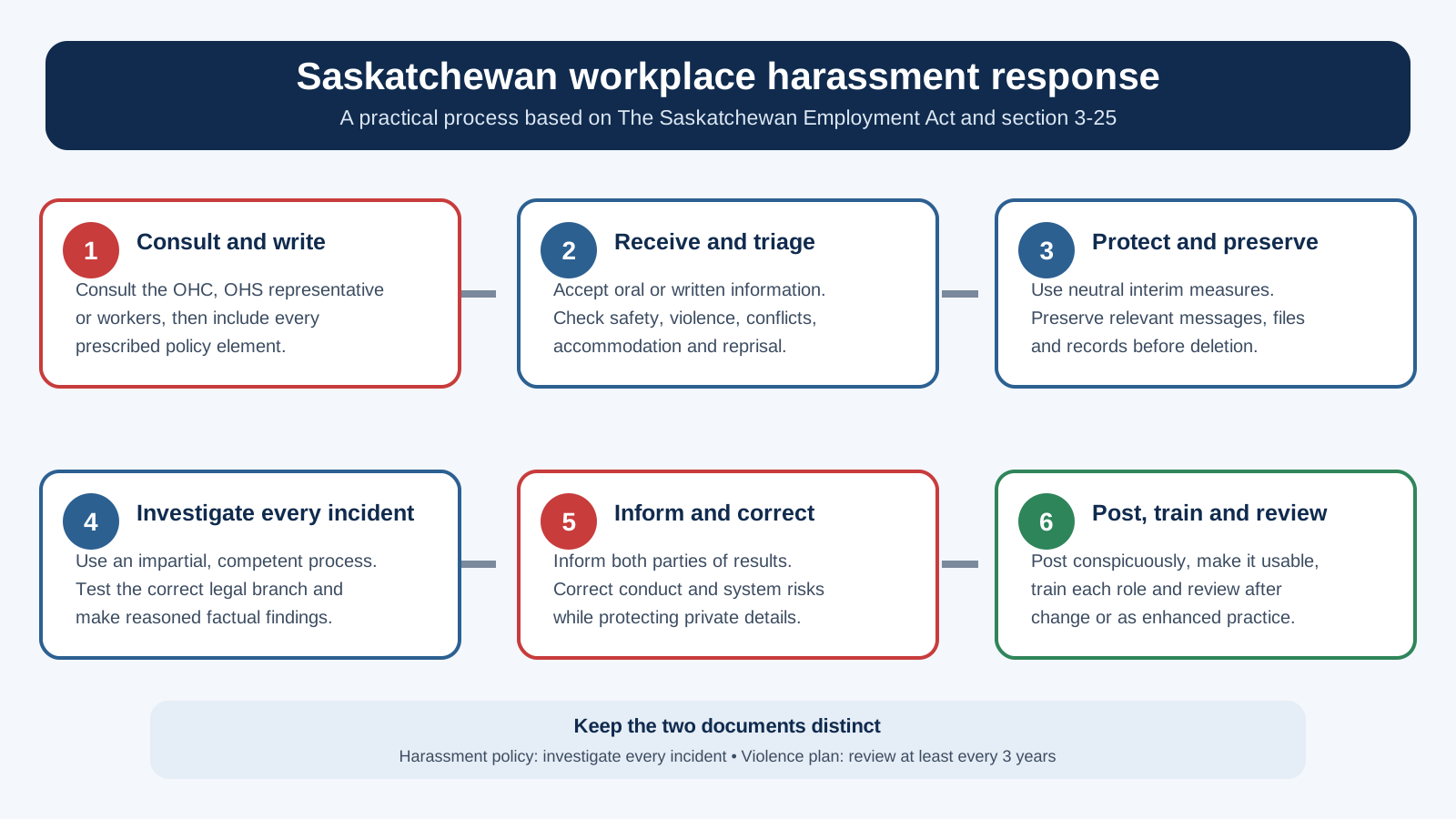
A practical Saskatchewan reporting process
A policy only works when workers know what to do. The following process is simple enough to remember and detailed enough to guide the employer.
Step 1: Receive the concern
Accept the report orally or in writing. Listen without deciding credibility on the spot. Record the date received, the people involved, the reported conduct, where and when it happened, possible witnesses, available records, immediate needs and the worker's preferred safe contact method.
Do not demand perfect legal words. A worker may describe “bullying,” “creepy messages,” “being singled out,” “a threat,” or “constant humiliation.” The trained recipient should identify the possible legal and policy issues.
Step 2: Triage safety and conflicts
Ask whether anyone is in immediate danger or needs medical care, emergency services, security, accommodation or another urgent support. Check whether the concern may involve violence, sexual assault, stalking, a weapon, self-harm, domestic violence, a child or vulnerable person, or another mandatory reporting issue.
Then screen the recipient, investigator and decision-maker for actual, potential or perceived conflicts. If the allegation involves an owner, senior executive, human resources leader or usual recipient, use the independent alternate route.
Step 3: Protect people and preserve evidence
Possible interim measures include no-contact instructions, changes to reporting lines, schedules or locations, remote work, security measures, temporary reassignment or paid leave. They should be neutral, proportionate, reviewed regularly and designed to avoid penalizing the reporting worker.
Preserve relevant emails, chats, texts, images, video, access records, schedules, notes and other records before automatic deletion. Do not use an evidence hold as an excuse for indiscriminate surveillance or collection unrelated to the allegations.
Step 4: Appoint an impartial, competent investigator
The investigator should understand Saskatchewan's three harassment branches, procedural fairness, trauma-informed interviewing, credibility assessment, privacy and the workplace context. Independence becomes especially important when allegations involve seniority, family relationships, small-community connections, prior involvement or a decision-maker's close colleague.
Use an external investigator when internal independence or competence cannot reasonably be protected. Record the conflict check and terms of reference.
Step 5: Investigate every incident fairly
The SEA requires the employer to ensure an investigation into any incident of workplace harassment. “Investigation” should be proportionate to the facts, but it must be real. A lower-level matter may require fewer witnesses and records than a complex sexual-harassment allegation; it still requires an impartial effort to understand what happened and decide the relevant issues.
A fair process usually includes:
- defining the allegations and policy or legal tests;
- giving the respondent enough particulars to answer;
- interviewing the complainant and respondent separately;
- interviewing relevant witnesses;
- reviewing relevant, reliable records;
- allowing the parties to address material conflicts in the evidence;
- assessing reliability and credibility without stereotypes; and
- making reasoned findings on the balance of probabilities.
Saskatchewan legislation does not set a universal 90-day deadline for every harassment investigation. An employer can adopt 90 calendar days as an enhanced target, provided it explains that the target may change with complexity, safety, availability, parallel proceedings or other justified circumstances. Give periodic status updates when an investigation takes longer.
Step 6: Inform, correct and follow up
Provide both parties with the investigation result as the policy promises. Communicate corrective action relevant to each recipient without unnecessarily disclosing private personnel information.
Correct the individual conduct and any underlying hazard or system weakness. Assign owners and dates. Then check whether the measures work and whether anyone is experiencing reprisal. Follow-up at 30, 90 and 180 days is a useful enhanced practice for significant cases, not a fixed statutory Saskatchewan schedule.
Sources
- https://www.saskatchewan.ca/business/employment-standards
- https://www.saskatchewan.ca/business/safety-in-the-workplace
- https://saskatchewanhumanrights.ca/your-rights/employment/
Should informal resolution be offered?
Informal resolution can be useful for suitable lower-level concerns when participation is voluntary and informed. It might involve a facilitated conversation, clear behavioural expectations, coaching or another agreed step. It should never be a compulsory gate before a worker can report harassment.
Informal resolution is normally unsuitable where there is violence, serious sexual or discriminatory conduct, coercion, retaliation, a major power imbalance, continuing danger, a need for formal findings or a pattern affecting other workers. The employer also cannot use a private agreement to avoid correcting a known workplace hazard.
If a complainant withdraws or asks the employer not to proceed, listen carefully and consider safety, privacy and trauma concerns. The request matters, but it does not automatically end the employer's duty. The employer may still know of an incident that must be investigated and may still need protective or preventive action.
Sources
- https://www.saskatchewan.ca/business/safety-in-the-workplace
- https://saskatchewanhumanrights.ca/your-rights/employment/
- https://www.saskatchewan.ca/business/employment-standards
Practical example 1: repeated public humiliation
Fictional example: A warehouse supervisor criticizes Jordan's work during the daily meeting for six weeks. The supervisor uses insults, imitates Jordan's voice and tells the team that Jordan is “too stupid to learn.” Co-workers begin laughing and excluding Jordan. Jordan reports anxiety, sleeplessness and fear of attending the meeting. The comments are not connected to a known protected ground and are not sexual.
The employer should not decide the case from the label “tough management.” It should assess the personal-harassment branch: Were the comments and gestures inappropriate? Did they adversely affect psychological or physical well-being? Did the supervisor know or ought reasonably to have known they would humiliate or intimidate? Did they constitute a threat to health or safety? The pattern and health effects are relevant.
Reasonable performance management remains possible. The employer may set standards and correct errors. But repeated insults and public ridicule are different from respectful direction. The investigator should obtain the exact words, meeting dates, witness evidence, performance records and any contemporaneous messages. Interim measures could change who conducts the meeting without reducing Jordan's hours or opportunities.
This is an example, not a conclusion about any real case. The final finding would depend on the evidence.
Practical example 2: one sexual incident
Fictional example: At a work-related client dinner, a senior employee sends Priya a sexually explicit image and then touches her lower back after she moves away. The next morning Priya tells a manager she does not want to complete a form and does not want to confront the senior employee.
The manager must still escalate what was reported. The sexual-harassment branch asks whether the conduct was sexual and whether the senior employee knew or ought reasonably to have known it was unwelcome. The employer should not import the personal-harassment requirement for repetition or a single serious occurrence with lasting harmful effect. It should not require Priya to tell the senior employee to stop before the policy applies.
The client dinner can be work connected even though it occurred outside the usual workplace and hours. The employer should preserve the message, screen safety and reprisal risks, appoint an impartial investigator and give the respondent fair particulars. Priya's wish not to complete a form should not prevent the employer from documenting the oral report and investigating the incident.
Again, this is fictional and does not predict a legal result in any actual matter.
Sources
- https://www.saskatchewan.ca/business/safety-in-the-workplace
- https://www.saskatchewan.ca/business/employment-standards
One Saskatchewan case study: an employer waited for a written complaint
The Saskatchewan Human Rights Commission publishes anonymous settlement summaries for educational purposes. One summary, identified as Settlement 15 (sex/harassment), fiscal 2020–21, describes a woman working in a traditionally male occupation. She alleged a physical assault, unwanted advances, sexual remarks and innuendo. She worked for the employer for about a year and felt compelled to resign.
According to the Commission's summary, the employer did not investigate because it said it would not act without a written complaint. The negotiated resolution preserved the employee's option to pursue a Workers' Compensation Board psychological-injury claim, and the employer paid $20,000 as damages to dignity.
This is an anonymous negotiated settlement summary—not adjudicated reasons, a finding after a hearing, an admission of liability or binding precedent. It should not be presented as a court decision. Its practical lesson is still clear: a reporting procedure should not make a signed written complaint the condition for employer action. Saskatchewan's occupational health and safety regime requires investigation of any workplace harassment incident. Once responsible management knows about an incident, it should document the information, assess immediate risks and begin an appropriate process.
The source is the Commission's official Saskatchewan human rights settlements collection. Employers should use the example to test their intake language: Can a worker report orally? Must supervisors escalate what they learn? Is an optional form mistakenly described as mandatory? Does the alternate route work when senior people are involved?
Sources
- https://www.wcbsask.com/how-report-work-injury
- https://www.saskatchewan.ca/business/safety-in-the-workplace
- https://saskatchewanhumanrights.ca/your-rights/employment/
- https://www.saskatchewan.ca/business/employment-standards
Confidentiality without promising secrecy
Overpromising confidentiality causes problems. An intake recipient should say that information will be shared only where necessary for safety, investigation, corrective action or law. The recipient should not say “no one else will ever be told.”
Use separate, access-controlled case files. Decide who needs each category of information. Avoid putting witness interviews or medical information in ordinary personnel files. Redact unnecessary personal details from management updates. Communicate interim measures without announcing unproven allegations.
Participants should be asked to protect privacy, but the instruction must be lawful and proportionate. It should not block communication with a union, lawyer, health professional, support person, regulator or police. It should not be used to conceal a hazard or suppress protected activity.
There is no universal Saskatchewan statutory rule requiring every harassment file to be kept for exactly seven years. A seven-year case-file period can be adopted as an enhanced internal standard after considering limitation periods, privacy, collective agreements, insurer requirements, legal holds and sector rules. Label it correctly and collect only what is reasonably needed.
Sources
- https://www.saskatchewan.ca/business/safety-in-the-workplace
- https://www.saskatchewan.ca/business/employment-standards
- https://www.saskatchewan.ca/business/hire-train-and-manage-employees/collective-bargaining-and-mediation
Protection from discriminatory action and reprisal
Workers must be able to raise health and safety concerns and participate in enforcement without punishment. Section 3-35 of the SEA addresses discriminatory action, and the Government of Saskatchewan provides a plain-English discriminatory-action overview.
The policy should prohibit retaliation for reporting in good faith, participating in an investigation, supporting another person, requesting occupational health and safety assistance or exercising another legal right. Watch for obvious and subtle forms: dismissal, discipline, reduced shifts, blocked training, hostile scheduling, threats, isolation, negative references or pressure to withdraw.
An allegation that is not substantiated is not automatically false or malicious. Evidence may be incomplete, witnesses may disagree, or the legal test may not be met. Discipline for bad faith should be reserved for deliberate fabrication or comparable misconduct established through a fair process—not a report that cannot be proven.
Sources
- https://www.saskatchewan.ca/business/employment-standards
- https://www.saskatchewan.ca/business/safety-in-the-workplace
- https://saskatchewanhumanrights.ca/your-rights/employment/
Training: make the written policy usable
A posted policy that no one understands is weak prevention. Training should match each role.
All workers should know:
- the three Saskatchewan harassment branches in plain language;
- examples of prohibited conduct and respectful management;
- the primary and alternate reporting routes;
- how to respond as a witness or bystander;
- what confidentiality can and cannot promise;
- how the investigation process works;
- where the violence plan and emergency procedures fit;
- how to seek accommodation or support; and
- that reprisal is prohibited.
Supervisors need additional instruction on receiving oral information, escalating known incidents, preserving evidence, avoiding premature credibility judgments, applying neutral interim measures and recognizing conflicts. Investigators need deeper competence in Saskatchewan's statutory tests and fair fact-finding. Committee members and representatives should understand their consultation role without being given confidential case details they do not need.
Keep attendance, training content, dates and competency checks. Refresh training after material policy changes, recurring failures, role changes or investigation lessons. Do not represent a single annual course as the only possible way to satisfy the employer's broader duties.
Sources
- https://www.saskatchewan.ca/business/safety-in-the-workplace
- https://saskatchewanhumanrights.ca/your-rights/employment/
- https://www.saskatchewan.ca/business/employment-standards
Posting and availability
Section 3-25 requires the employer to implement the harassment policy and post it conspicuously where it is readily available for reference by workers. Physical posting remains important at many sites. A digital copy can improve access for remote and mobile workers but should not become an excuse for a hidden document behind unfamiliar navigation or unavailable credentials.
Use the languages and accessible formats needed by the workforce. Tell new workers where the policy is during orientation. Put the names or roles and secure contact details of the current recipients directly in the policy or in a controlled schedule that is updated promptly.
Keep evidence: photographs of physical posting locations, intranet screenshots, orientation records, revision notices and acknowledgements. If a worker cannot find the policy or does not know whom to contact, posting has not achieved its practical purpose.
Sources
- https://www.saskatchewan.ca/business/safety-in-the-workplace
- https://www.saskatchewan.ca/business/employment-standards
Reviewing the harassment policy
Saskatchewan does not impose the violence plan's three-year review cycle on the harassment policy. Even so, an annual review is a strong enhanced control. The review should ask:
- Is the occupational health committee, representative or worker consultation record current?
- Are the primary and alternate recipients still available, independent and trained?
- Can remote, night, mobile and third-party workers report safely?
- Did investigations start promptly and finish within reasonable target times?
- Were both parties meaningfully informed of results?
- Did corrective actions reduce the risk?
- Did anyone experience reprisal?
- Are there recurring locations, teams, behaviours or power imbalances?
- Have Saskatchewan laws, official guidance, contracts or workplace circumstances changed?
- Does the separate violence plan need its statutory three-year or change-triggered review?
Material revisions should go through the same required consultation route and be communicated to workers. Keep the previous version, the reasons for change and proof of re-posting and training.
Sources
- https://www.saskatchewan.ca/business/safety-in-the-workplace
- https://www.saskatchewan.ca/business/employment-standards
Common Saskatchewan policy mistakes
Using a one-paragraph zero-tolerance statement
A slogan does not supply the prescribed definition, reporting procedure, confidentiality rule, external rights, results procedure and other required contents. Use a complete policy.
Requiring a signed written complaint
Forms are useful, but oral information must be received and documented. Supervisors must escalate known incidents. The employer's investigation duty is not safely postponed until a worker signs a form.
Applying the personal-harassment test to every branch
Do not require repetition or lasting harm for protected-ground or sexual harassment. Do not use the personal branch's reasonable-management exclusion as a defence to every allegation.
Treating all unpleasant conduct as statutory harassment
Personal harassment includes specific health, safety, impact and knowledge elements. A respectful but unwelcome performance decision may not be harassment. The employer can still correct incivility under broader internal standards.
Forgetting the alternate reporting route
A worker needs somewhere credible to go when the owner, supervisor, human resources contact or usual recipient is involved or conflicted.
Confusing harassment and violence documents
All Saskatchewan workplaces now need the violence policy statement and prevention plan. The harassment policy does not replace it. The violence plan's statutory three-year review does not automatically become a harassment-policy deadline.
Promising a legal 90-day investigation deadline
Saskatchewan does not set a universal 90-day deadline for every harassment investigation. A 90-day target can be a strong service standard if it is labelled as an enhanced target and delays are explained.
Giving no meaningful result
The policy must explain how the complainant and alleged harasser will be informed of investigation results. “Closed” is not a useful result. Communicate the conclusion and relevant corrective action while protecting unnecessary personal information.
Ignoring third parties and digital conduct
Customers, clients, patients, contractors and online communications can create workplace risks. The employer's response options may differ, but prevention and protective action still matter.
Treating an unsubstantiated complaint as misconduct
Not proven does not mean fabricated. A bad-faith finding needs its own evidence and fair assessment.
Sources
- https://www.saskatchewan.ca/business/safety-in-the-workplace
- https://www.saskatchewan.ca/business/employment-standards
Saskatchewan employer implementation checklist
Use this checklist before issuing the policy:
- Confirm that Saskatchewan provincial law governs the workplace.
- Insert the employer's legal name, workplaces and effective date.
- Include the accurate three-branch harassment definition.
- State the right to employment free from harassment.
- Commit to every reasonably practicable prevention effort.
- Explain corrective action for a person under the employer's direction.
- Name a primary and genuinely independent alternate reporting route.
- Accept oral, written, witness and representative-assisted reports.
- Explain the confidentiality exceptions accurately.
- Refer to occupational health and safety officer assistance.
- Refer to the Saskatchewan Human Rights Code and Commission complaint route.
- Explain how both parties will receive investigation results.
- Preserve other legal rights.
- Consult the OHC, OHS representative or workers in the statutory sequence.
- Connect the policy to the separate violence statement and prevention plan.
- Establish emergency triage, interim measures and evidence preservation.
- Appoint and train impartial investigators.
- Investigate every incident and make reasoned findings.
- Set realistic enhanced timing and status-update standards.
- Protect against discriminatory action and reprisal.
- Implement, communicate and conspicuously post the policy.
- Train workers, supervisors, recipients and investigators for their roles.
- Keep proportionate, secure records and apply legal holds where needed.
- Review the harassment policy annually as enhanced practice.
- Review the violence plan at least every three years and when circumstances change.
You can also use Canada Policy Manual's Compliance Gap Checker to organize an internal readiness review. It is a practical screening tool, not a legal opinion.
Sources
- https://www.saskatchewan.ca/business/safety-in-the-workplace
- https://saskatchewanhumanrights.ca/your-rights/employment/
- https://www.saskatchewan.ca/business/employment-standards
Download the free Saskatchewan policy template
The article explains the rules; the template turns them into a detailed starting document.
Download the Free Saskatchewan Workplace Harassment Prevention Policy Template
Before publishing the template inside the workplace, replace every bracketed field, identify real recipients, complete the required consultation, coordinate the separate violence plan, add site-specific controls, confirm sector requirements, train the responsible people and obtain legal review where appropriate.
Employers that want to build a broader, organized HR policy manual can create a Canada Policy Manual account. The free Saskatchewan harassment template remains the main resource for this page.
Sources
- https://www.saskatchewan.ca/business/safety-in-the-workplace
- https://www.saskatchewan.ca/business/employment-standards
Frequently asked questions
1. Does every Saskatchewan employer need a workplace harassment policy? Every provincially regulated Saskatchewan employer must develop and implement a written harassment prevention policy using the consultation route in section 3-21.1 of the SEA. Federally regulated undertakings follow the federal regime, so confirm jurisdiction first.
2. Who must the employer consult when developing the policy? Consult the occupational health committee if one exists. If there is no committee, consult the occupational health and safety representative if one exists. If neither exists, consult the workers. Keep evidence of meaningful consultation.
3. Must a Saskatchewan harassment complaint be in writing? No special signed form should be made a condition of action. The policy should accept oral and written reports, and supervisors should escalate incidents they learn about. A form may be optional and useful for organizing information.
4. Does the employer have to investigate every incident? Section 3-21.1 requires the employer to ensure an investigation into any incident of workplace harassment. The scope can be proportionate to the seriousness and complexity, but the response must be real, impartial and fair.
5. Is one incident enough to be harassment? It can be. Sexual or protected-ground harassment should be assessed under their own statutory branches. For personal harassment, one serious occurrence can qualify if it has a lasting harmful effect; repeated occurrences can also qualify when the other elements are met.
6. Is reasonable performance management harassment? Reasonable action relating to management and direction is excluded from the personal-harassment branch. The action must actually be reasonable. Abusive, humiliating, discriminatory or sexual conduct is not protected merely because it happened during management activity.
7. Does the policy cover contractors, students and volunteers? Part III's worker coverage can extend beyond conventional employees, including students in training, volunteers and certain independent or dependent contractors. Employers should confirm the statutory relationship and draft broad practical coverage.
8. Can harassment happen online or outside working hours? Yes, when there is a sufficient workplace connection. Email, text, chat, video meetings, social media, work travel, client events and employer-related gatherings can all create workplace harassment issues.
9. Must the employer give both parties the full investigation report? Not automatically. The policy must explain how the complainant and alleged harasser will be informed of results. The employer should provide a meaningful written conclusion and relevant corrective-action information while protecting unnecessary personal information and complying with other legal duties.
10. Is there a 90-day legal deadline for Saskatchewan harassment investigations? There is no universal 90-day statutory deadline for every Saskatchewan harassment investigation. An employer may adopt 90 days as an enhanced target, document justified extensions and provide status updates.
11. How often must the harassment policy be reviewed? Saskatchewan's regulations do not apply the violence plan's statutory three-year cycle to the harassment policy. Annual review is a strong enhanced practice, with earlier review after legal changes, incidents, recurring problems or process failures.
12. Does every Saskatchewan workplace also need a violence prevention plan? Yes. Since May 17, 2024, all provincially regulated Saskatchewan workplaces must have the required violence policy statement and prevention plan. That plan must be reviewed at least every three years and when circumstances change in a way that may affect health or safety.
13. Can a worker contact an occupational health officer or the Human Rights Commission? Yes. The harassment policy must refer to the right to request assistance from an occupational health officer and to the Saskatchewan Human Rights Code and Commission complaint route. The policy must not discourage other legal rights.
14. Where should the policy be posted? It must be conspicuously posted where it is readily available for workers' reference. Use physical and accessible digital locations appropriate to the workforce, and keep evidence that the current version was communicated and posted.
Sources
- https://www.saskatchewan.ca/business/safety-in-the-workplace
- https://www.canada.ca/en/employment-social-development/programs/workplace-health-safety.html
- https://saskatchewanhumanrights.ca/your-rights/employment/
- https://www.chrc-ccdp.gc.ca/individuals/human-rights/about-discrimination
- https://www.saskatchewan.ca/business/employment-standards
- https://www.priv.gc.ca/en/privacy-topics/employers-and-employees/
- https://laws-lois.justice.gc.ca/eng/acts/a-0.6/
- https://laws-lois.justice.gc.ca/eng/acts/l-2/index.html
Final takeaway
A reliable Saskatchewan workplace harassment policy is an operating system, not a promise on paper. It uses the correct three-part legal definition, preserves reasonable management without excusing abuse, gives workers a safe reporting route, accepts oral information, protects privacy, investigates every incident, informs both parties of results, corrects risks, prevents reprisal and remains visible to the workforce.
Keep the harassment policy connected to—but legally distinct from—the mandatory violence prevention plan. Consult the correct workplace party, train everyone with a role, document implementation and review performance regularly.
Start with the free Saskatchewan workplace harassment prevention policy template, customize it for the workplace, and obtain Saskatchewan legal advice for complex or high-risk situations.
Authoritative Saskatchewan sources
- The Saskatchewan Employment Act — King's Printer consolidation
- The Occupational Health and Safety Regulations, 2020 — King's Printer consolidation
- Government of Saskatchewan — Bullying and harassment in the workplace
- Government of Saskatchewan — Preventing violence in the workplace
- Saskatchewan Human Rights Commission — Settlement summaries
Final disclaimer: This general educational guide and linked template are not legal advice, do not create a solicitor-client relationship and cannot account for every workplace, sector, collective agreement or fact pattern. Confirm current law and obtain qualified Saskatchewan advice before relying on the material. Canada Policy Manual does not promise that using a template will prevent incidents, claims, orders, penalties or liability.
Key Takeaways
- Saskatchewan employers need a written harassment policy developed through the required consultation sequence and containing the prescribed section 3-25 elements.
- The three statutory branches—protected-ground or size/weight, personal, and sexual harassment—must be assessed using their distinct legal tests.
- Reports may be oral or written, every incident must be investigated, both parties must receive investigation results, and corrective action must address conduct and system risks.
- The harassment policy and the separate violence prevention plan must remain distinct; the statutory three-year review cycle applies to the violence plan, not automatically to the harassment policy.
Disclaimer: General information, not legal advice or a compliance guarantee. Confirm Saskatchewan jurisdiction, current law and workplace-specific duties before adoption. Laws, official guidance, collective agreements and sector rules can change after August 13, 2026.